
Landmark report’s blueprint for a safer therapy future
The independent Commission for the Future of Counselling and Psychotherapy has published its landmark report, Unlocking Potential: transforming lives, setting out a vision for a profession that is safer, stronger and better equipped to meet the UK’s growing mental health needs.
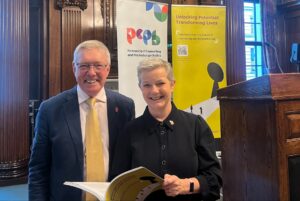
Commission co-chairs Andrea Sutcliffe and Phil Hope at the launch of the report.
Established by the Partnership of Counselling and Psychotherapy Bodies (PCPB), of which HGI is one of the six founder members, the independent Commission was asked to examine the current and emerging issues facing the profession and the barriers that affect people’s access to therapy. Its work brought together perspectives from across all four nations of the UK, drawing on evidence from more than 4,000 practitioners, employers, commissioners, researchers and people with lived experience.
The Commission heard that around 14 million people across the UK are estimated to be experiencing mental health problems, while many struggle to access timely support. At the same time, the Commission found substantial, unused capacity within an existing workforce of around 82,000 qualified counsellors and psychotherapists on Professional Standards Authority (PSA) accredited registers. Practitioners represented across the six PCPB partners reported capacity to provide an additional 370,000 therapy hours each week.
The report estimates that using just 10 per cent of this spare capacity could enable more than 150,000 additional people to receive therapy each year, at a cost equivalent to 0.56 per cent of the UK mental health budget.
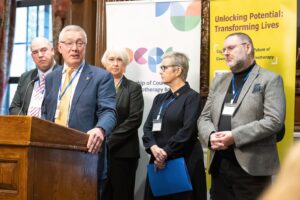
Commission co-chair Phil Hope addresses the audience at the launch of the Commission. Photo by Rebecca Cresta Photography
The report highlights that closing the treatment gap is not only about training more practitioners or securing additional investment. It also requires a coherent, long-term approach to commissioning, workforce planning, professional development, regulation, evaluation and deployment. Better use of counselling and psychotherapy can support earlier intervention, widen access in neighbourhood and community settings, and help prevent difficulties from escalating.
Recommendations are based around six connected strategic priorities:
- Improve commissioning and funding
- Strengthen public protection
- Build a sustainable and diverse workforce
- Strengthen the evidence base
- Raise public and political recognition
- Give the profession a stronger collective voice
Each priority is backed by practical recommendations, including actions tailored to the different policy and service contexts of England, Scotland, Wales and Northern Ireland.
Andrea Sutcliffe, independent co-chair of the Commission, said: “The Commission makes a clear case for seeing counselling and psychotherapy as a core component of the UK’s mental health infrastructure – backed by the funding, workforce planning, regulation and evidence needed to realise their full potential.”
From recommendations to action
Turning this roadmap into meaningful change will depend on continued collaboration between professional bodies, governments, policymakers, commissioners, employers, researchers, practitioners and people who use mental health / therapeutic services.
The PCPB will work with partners across the sector to build on the report’s evidence, develop the recommendations and support a more strategic approach to how the counselling and psychotherapy workforce is commissioned, valued and integrated within services. The profession itself also has an essential role in continuing to raise standards, improving diversity, demonstrating impact and speaking with a stronger collective voice.
Read the report – Unlocking Potential: transforming lives
Published: 25th Nov 2026